
Who writes this page?
I have taken this examination about twenty times, and I have performed most of the tests it contains from the other side. I describe the booth from the inside, and I explain the curve as I was taught to read a tracing. But I am not a doctor: I do not interpret any audiogram, and especially not yours.
In short
Your hearing is tested at every examination, but by a simple voice test. The audiogram, however, does not happen every year: it is required in class 1, and in class 2 only if you add an instrument rating. The threshold for the initial applicant in class 1: no more than 35 dB of loss at 500, 1000 or 2000 Hz, nor 50 dB at 3000 Hz, in each ear separately. And the point that changes everything for revalidation: the regulation expressly provides that an applicant whose loss exceeds these thresholds may demonstrate satisfactory functional hearing ability. This is a burden of proof, not an automatic authorisation, and it does not concern the initial applicant.
First: two different examinations, often mistaken for one another
The regulation is clear on the principle: hearing is tested at all examinations. It is written in black and white in point MED.B.080 of Annex IV to the European regulation. But "tested" does not mean "audiogram".
What happens at each visit is a voice test: understanding a conversational voice, each ear separately, at a distance of 2 metres, back turned. Simple, fast, without a machine. This precise protocol is not found in the regulation itself but in the Acceptable Means of Compliance (AMCs), published separately by the European Union Aviation Safety Agency (EASA); I was not able to collate the AMC text for this page, so I give it to you as the commonly described protocol, not as a quotation.
Pure-tone audiometry, the audiometer, the booth, the curve, follows a completely different schedule:
- Class 1: yes.
- Class 2: only if an instrument rating is added to the licence.
- Periodicity: at the initial examination, then every 5 years until age 40, then every 2 years.
Many pilots believe they take an audiogram every year. This is not the case, and knowing which of the two tests awaits you saves you from worrying for nothing.
Two clarifications, because the short formula "no audiogram in class 2 except IFR" is right in principle but misleading in practice. First, the trigger is the addition of an instrument rating to the licence (IR, or en route / basic rating according to the current terminology, the vocabulary has shifted in recent years), not the fact of flying on instruments. And when such a rating is added to a private licence, both the periodicity AND the class 1 thresholds apply. An IR holder who never flies on instruments is affected; a class 2 pilot who flies IFR without holding the rating is not.
Second, and this is a caveat that matters: the regulation opens a door across all classes. In case of hypoacusis, middle or inner ear disease, tympanic membrane perforation, tubal dysfunction, vestibular disorder or sequelae of ear surgery, a further examination is provided for. In practice: with an ENT history of this type, an audiogram may be requested of you even in class 2 without an instrument rating. (One also reads that failing the voice test is enough to trigger it: this detail comes from the UK authority's guidance, so I do not reproduce it as applicable law here.) And for tubal dysfunction or balance disorders, the assessment is done in consultation with the licensing authority's medical assessor, again without any instrument rating being involved.
The pilot's take, initial vs renewal
The initial class 1 examination is significantly more thorough and time-consuming. The doctor does not know you: they must explore everything, and the audiogram is more complete. For renewals, they know where you are starting from and target what needs to be: the whole process is much faster. It is not complacency, it is follow-up: they compare your curve to those of previous years. That is what I have seen done at every renewal.
Inside the booth: the process, from the door to the curve
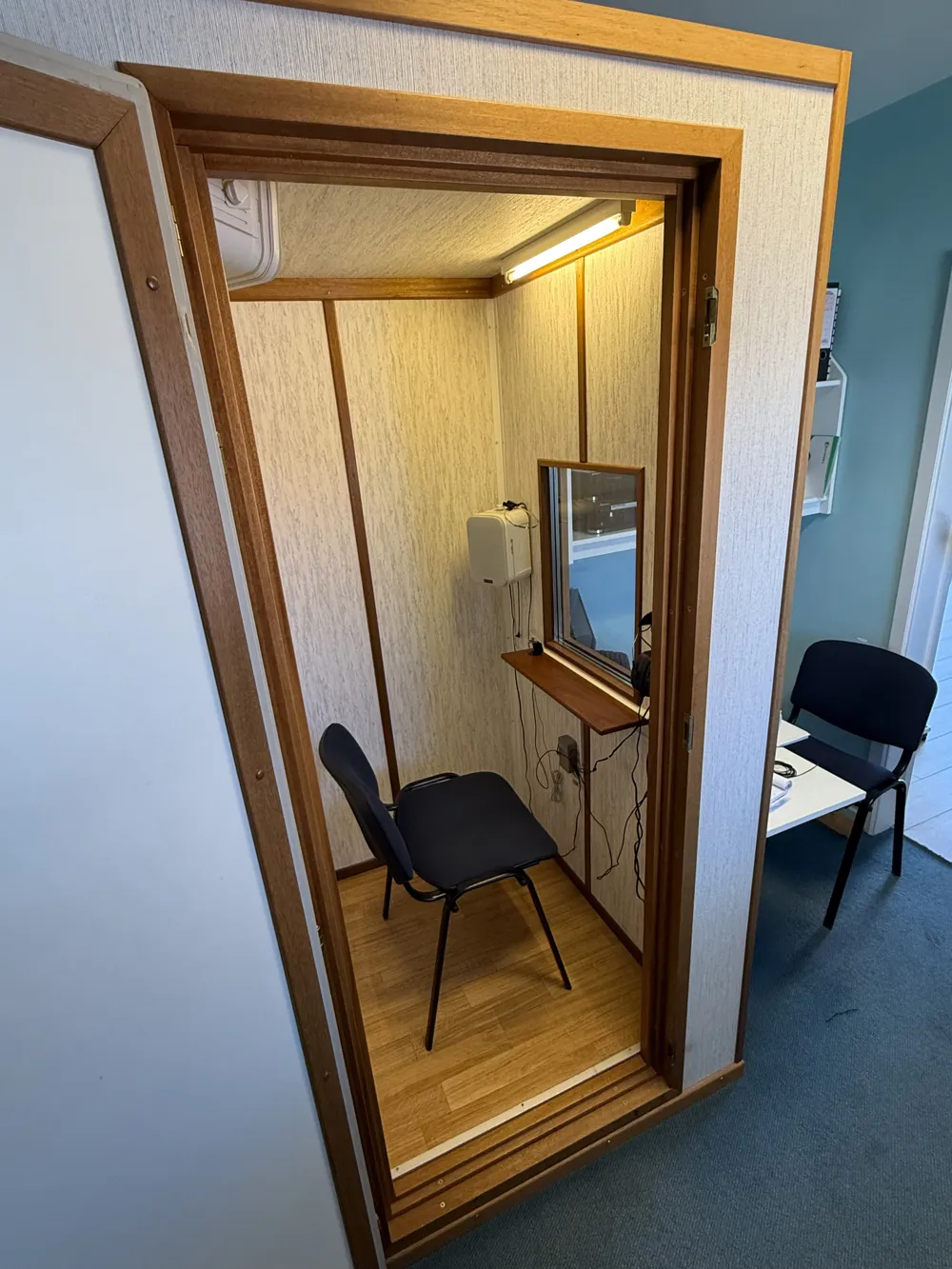
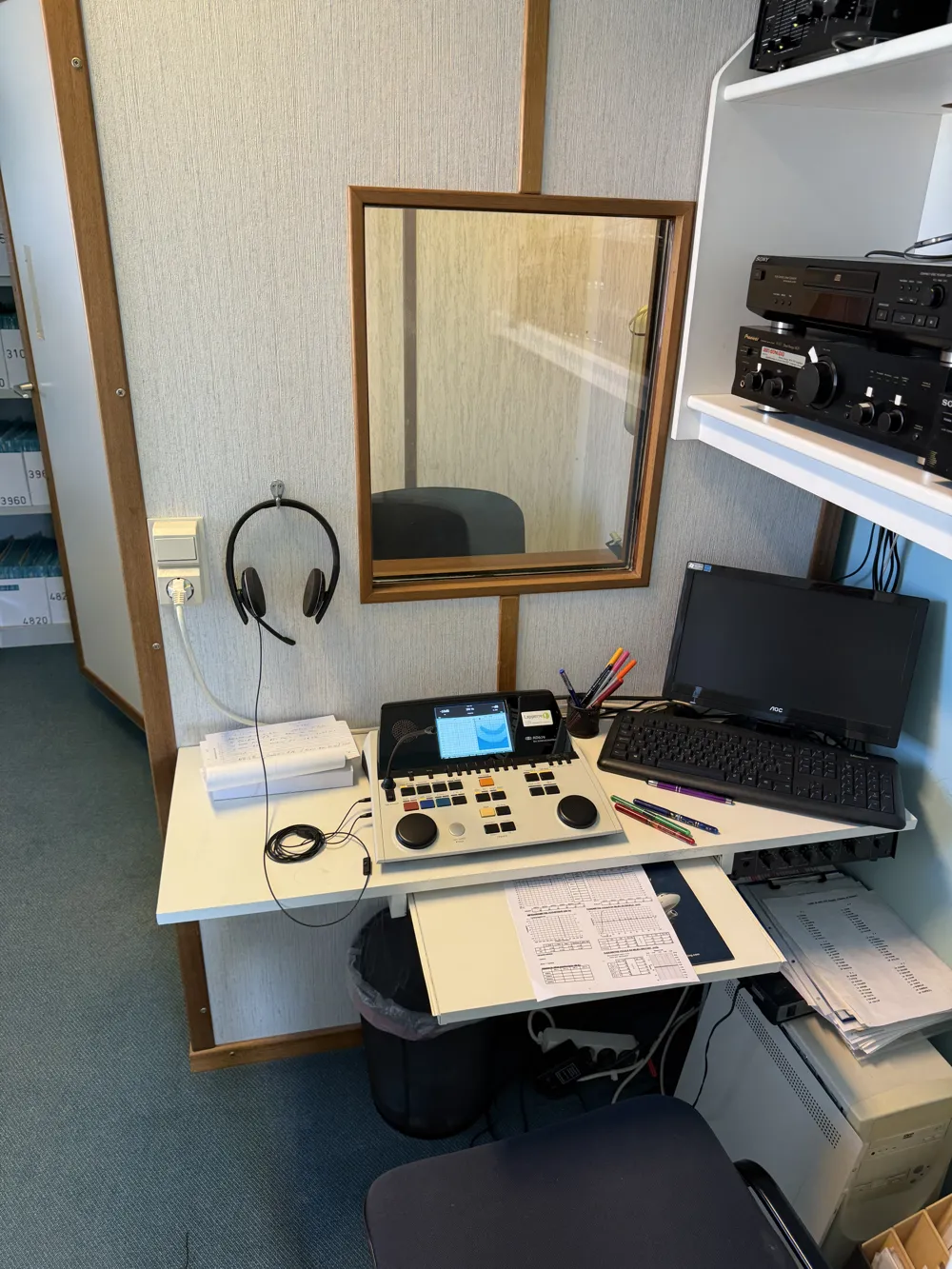
The ones I have seen all looked alike. A small soundproof room (about the size of a department store fitting room, say 1.50m by 1.50m and 2.50m ceiling height) closed by a thick door. The interior is padded, usually with a dark, black carpet-like covering: sober, austere. A small window separates you from the doctor, sitting right across. You are on a chair, wearing a headset, with a push-button in your hand: the same kind as a patient call bell in a hospital.
The pilot's take: what you will really hear
You have to experience it to understand it, so here is the most accurate image I could find. At the lowest levels, the sounds sent to the headset are felt more than they are heard. It is exactly like a mosquito arriving from very far away in the middle of the night: long before you really hear it, you perceive that faint and weirdly intense vibration of its wings. It is not yet a sound; it is your ear warning you that something is approaching.
Knowing this in advance changes everything. You stop doubting, "did I hear it, or am I imagining it?", and you signal at the right time.
When the door closes, the outside disappears, exactly like when you put on an active noise reduction (ANR) headset: you can barely hear anything, to the point that if you concentrate, you perceive your own heart, like when you plug your ears with your fingers. The doctor gestures through the window to indicate it is starting. Personally, I close my eyes: without sight, I focus entirely on hearing.
Then the sounds arrive, sometimes on the left, sometimes on the right, sometimes both. At each frequency, the volume starts very low and rises very slowly until I perceive something, and then, I press. It is this threshold, ear by ear, that plots the curve. The whole thing lasts two to four minutes, hard to say as one is so focused. The results are immediate: as you exit, the doctor displays the graph on the screen and compares it to previous years.
Can you "cheat"? No. In all the tests I have taken, the sounds never came at regular intervals. Sometimes two in a row, sometimes nothing for ten or fifteen seconds. Impossible to anticipate by counting in your head, and that is precisely the point. A useful consequence to know: a silence does not mean your hearing is failing, it is often just a long interval. Do not let the blanks unsettle you.
Reading the curve: the decoder
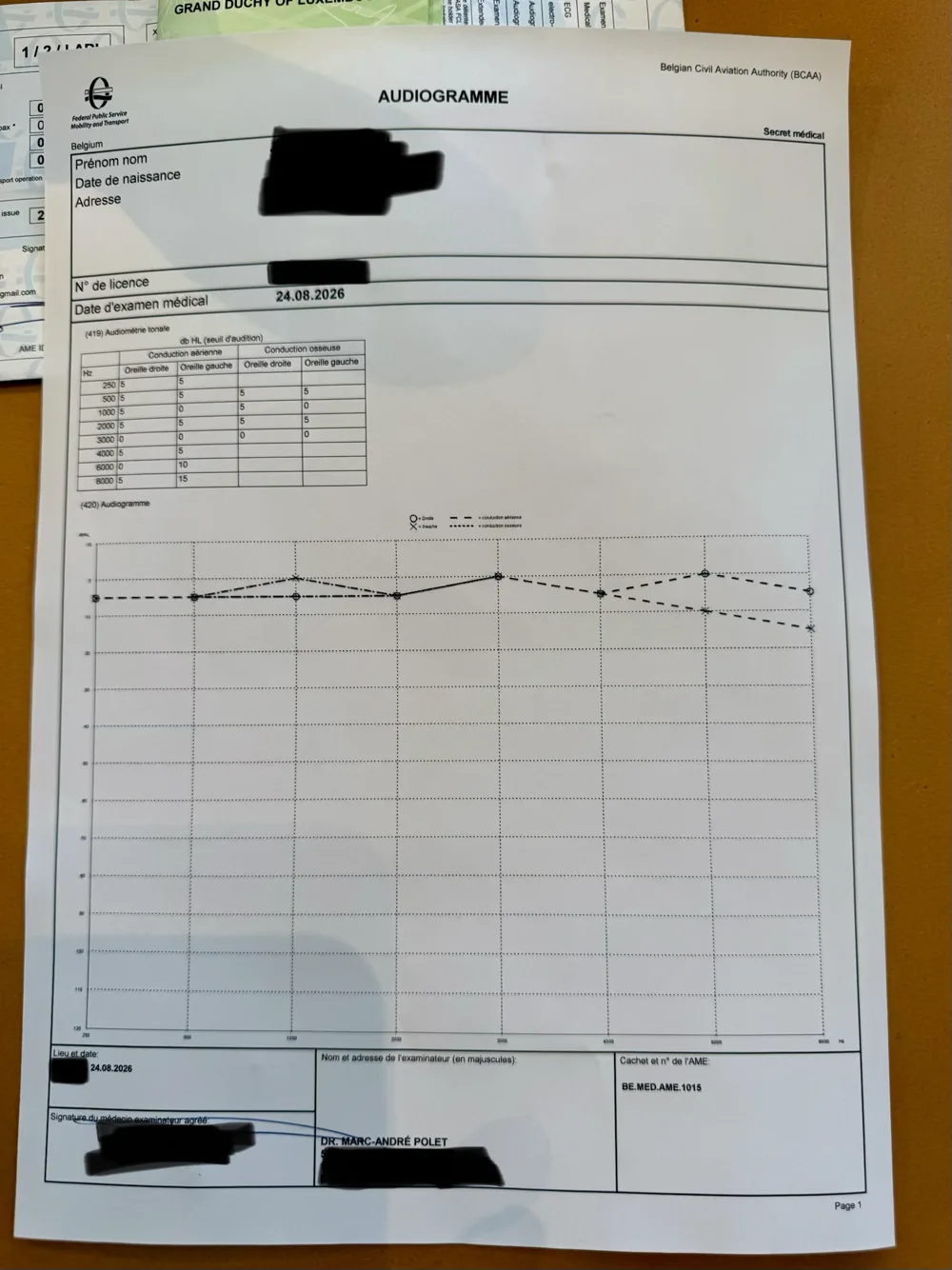
An audiogram is read like a tracing, a bit like an ECG, on paper or on screen. Two axes, and a colour convention.
| What you see | How it is read |
|---|---|
| Horizontal axis | The frequencies, in hertz. Like a piano keyboard: the low notes on the left, the high notes on the right (500, 1000, 2000, 3000 Hz...). |
| Vertical axis | The volume, in decibels. Right at the top, the faintest sounds. The further down you go, the more volume it took for you to hear. |
| Red circles | Right ear. This is the convention. |
| Blue crosses | Left ear. |
| A roughly flat and high line | The tracing of a hearing that did not need volume to hear. |
| A curve that dips in the high frequencies (around 3, 4, 6 kHz) | The profile classically associated with acoustic trauma, exposure to noise, cockpit included. It is a profile, not a diagnosis. Note: the regulation only sets numerical thresholds at 500, 1000, 2000 and 3000 Hz. Higher frequencies, 4 and 6 kHz, where the literature locates noise-related damage, do not have a regulatory threshold. What is actually measured during the examination falls under the protocol, hence the AMC which I was not able to collate: I do not state it. |
The reading direction is surprising the first time: as the doctor gradually increases the volume and you eventually perceive the sound, the point is plotted lower the louder your ear needed it to be. It is not a severity scale: the next section explains why.
The core trap: "normal" and "fit" are not the same thing
This is the most costly confusion on the subject: it makes people read an audiogram with the wrong grid.
The clinical benchmark of "normality", roughly, thresholds between -10 and 20 dB HL ("HL" for hearing level: the level referenced to normal hearing), is not the fitness threshold. For the licence, what matters are the Part-MED thresholds: 35 dB and 50 dB for initial class 1, detailed just below. In other words: one can fall outside "clinical normality" and remain perfectly within regulatory criteria.
If a hearing aid acoustician or an app tells you of a "mild loss", this vocabulary is clinical. It says nothing about your fitness file. Do not draw any conclusions from your curve alone, this is the role of your AME, the approved aeromedical examiner, and only them. (For a class 1 initial, the examination takes place in an approved aeromedical centre, an AeMC.)
The thresholds: how far can it go?
| Situation | What the regulation provides |
|---|---|
| Initial applicant, class 1 (and class 2 if an instrument rating is added to the licence) | No loss greater than 35 dB at 500, 1000 or 2000 Hz, nor greater than 50 dB at 3000 Hz, in each ear separately. |
| Revalidation or renewal The line to remember with greater loss | The text expressly provides that the applicant may demonstrate satisfactory functional hearing ability. It is neither a second numerical threshold, nor a simple favour from the AME: it is a regulatory provision. |
| Hypoacusis noted | Further examination establishing that the condition does not interfere with the safe exercise of the privileges. |
| Who decides next | Class 1: the applicant is referred to the medical assessor of the licensing authority. Class 2: fitness is assessed in consultation with the medical assessor, including without an instrument rating for tubal dysfunction and vestibular disorders. A European mechanism, not a national peculiarity. |
Three words to distinguish, because everything depends on it: initial is the first time; revalidation is taking the examination in the 45 days preceding expiry; renewal is outside this window, whether too early or too late. ⚠️ The demonstration path in the second row does NOT apply to the initial. An applicant taking their first examination is bound by the numerical thresholds, with no alternative.
And the "medical assessor" is the doctor at the licensing authority, the DGAC in France, who decides cases that an AME cannot conclude alone. If their decision is not in your favour, ways to appeal exist: see unfitness and appeal.
The line to remember from the table is the second one. It is more favourable to the pilot than what is generally read: exceeding a threshold at revalidation is not the end of the discussion, it is the beginning of a demonstration provided for by the text.
An obsolete figure is still circulating: 20 dB. It comes from the old FCL 3, the JAR-FCL standard of the JAA, implemented in France by the decree of 27 January 2005, which cited 20 dB at 500/1000/2000 Hz and 35 dB at 3000 Hz at initial. These values are no longer in force since the transition to the European Part-MED. If you come across "20 dB" in a document or on a forum, you are reading an outdated text. ⚠️ Be careful not to confuse: that 20 dB was a fitness threshold, it has nothing to do with the 20 dB HL of clinical normality mentioned above.
"My curve is not perfect", should I be worried?
Hearing that is not perfect is not synonymous with unfitness. First, because the regulatory thresholds leave a real margin compared to the clinical normal. Second, because exceeding them opens a pathway, further examination, referral, or consultation, rather than an automatic refusal. And because at revalidation, the regulation provides this functional demonstration pathway.
What I will not do is tell you how often the outcome is favourable. There are no public statistics on this, and on a fitness issue, one does not replace a missing figure with a reassuring impression. I describe a pathway; I do not promise a result.
The pilot's take: the first time
The first time, you are easily unsettled: the dark booth, the feeling of being locked "in a fridge", and those sounds that are more vibrations than clear sounds. Some people somewhat fail their first attempt simply because they are thrown off, and doctors know it.
Yours is right behind the glass. Wave at them, tell them something is wrong: they will explain it again, and the second attempt generally goes much better. For renewals, when you know what to expect, it is disconcertingly easy.
Arriving on familiar ground: the at-home pre-test
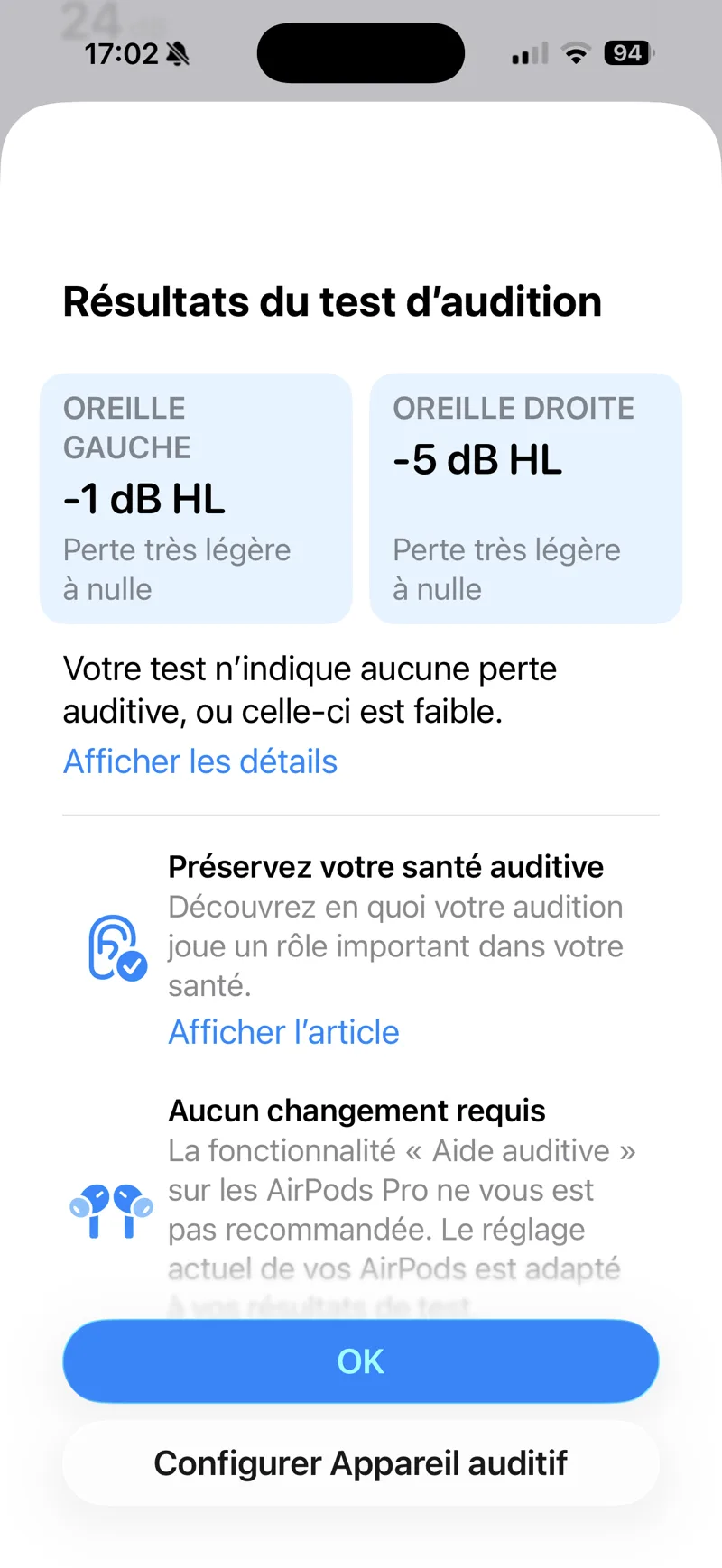
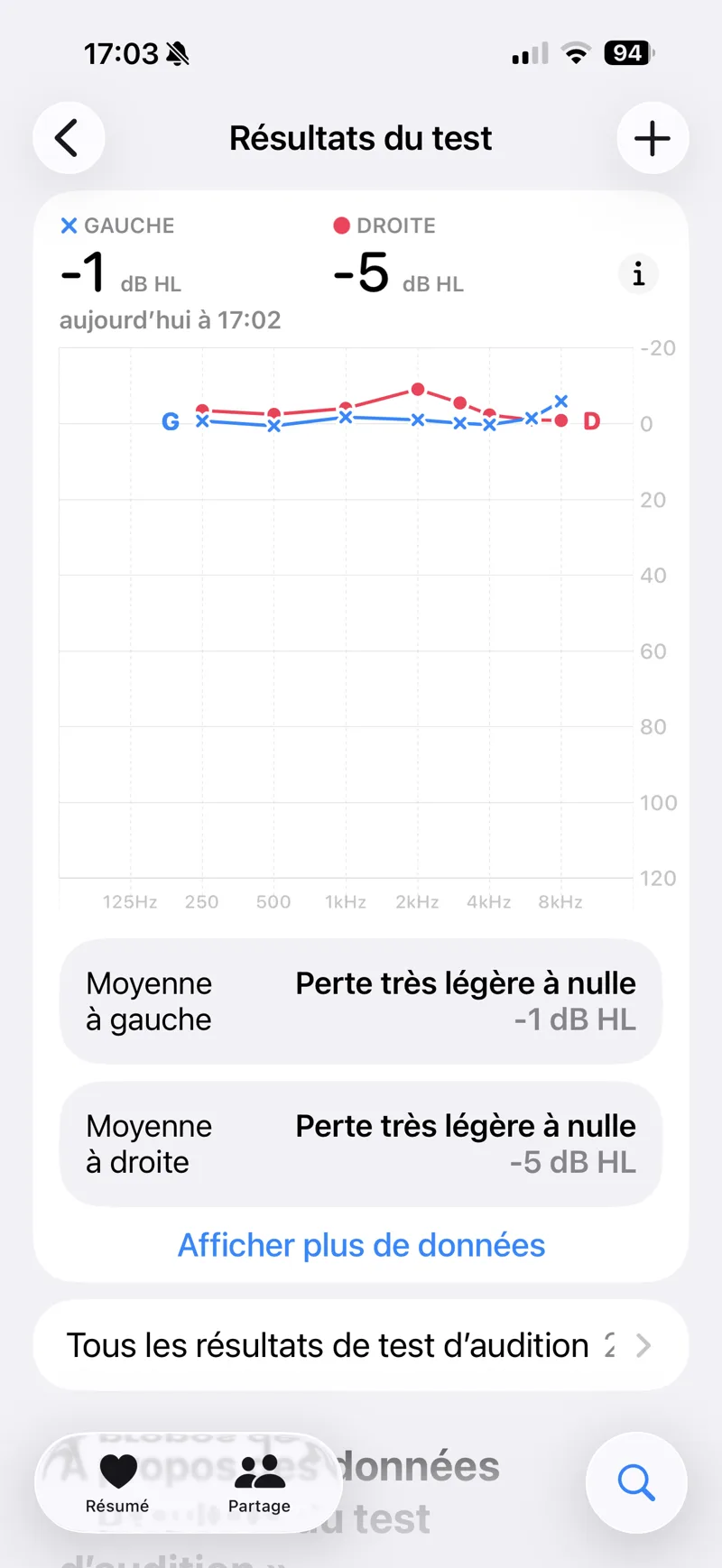
A consumer hearing test (AirPods Pro, iPhone) produces a curve of the same shape as an audiogram. Useful for arriving in familiar territory, but it is not a fitness examination: only the official audiogram counts.
The AirPods Pro 2 and 3 integrate a hearing test based on pure-tone audiometry: the same pure tone logic as the booth, giving a result in dB HL per ear and an exportable audiogram. The feature arrived with iOS 18.1 in late 2024 on the Pro 2, and the Pro 3, released in September 2025, includes it.
It is not a medical examination, Apple itself presents it as a non-diagnostic tool. But it is an excellent way to familiarise yourself with the exercise before the big day, and to track your hearing over time.
- The right hardware. AirPods Pro 2 or 3: other models do not offer the feature.
- Clean tips. Earwax in a tip, and the result is skewed.
- Not having a cold. With a cold or a sinus infection, you inevitably hear less well.
- Rested ears. Especially not after a concert or a noisy environment: temporary auditory fatigue degrades the test.
- In absolute quiet. At the slightest ambient noise, it is impossible to concentrate on sounds at the limit of audibility.
- Several times. A few days apart, morning and evening, in different places, to see if your perception varies.
I use it regularly, and it matches my Class 1 renewal audiograms fairly closely. It is an impression, not a numerical comparison: I have not yet put the two tracings side by side. It is therefore neither a scientific validation nor an invitation to compare yours.
The headset is not a comfort item
The best way to keep a good curve is not to damage it. Exposure to cockpit noise degrades hearing in the high frequencies: the area that literature associates with acoustic trauma (3, 4, 6 kHz). An active noise reduction (ANR) headset reduces exposure to noise in flight: the subject is treated in detail on the hearing page.
Decoding your audiogram means understanding why the headset is not a comfort accessory but protective equipment. Your audiogram is the assessment; the headset is the prevention. The subject is covered on the pilot hearing protection page.
Frequently asked questions
Is the audiogram mandatory at every medical examination?
Do you need perfect hearing to be a pilot?
What happens if I exceed a hearing threshold?
What is the difference between normal hearing and fit hearing?
Can you cheat on the audiogram?
How long does the booth test take?
Can the AirPods Pro hearing test replace the examination audiogram?
I failed my first time in the booth, is it serious?
Are hearing thresholds the same everywhere in Europe?
Further reading
This page covers one specific station of the examination. For the whole picture: the overview page on the medical examination (classes, validity periods, age limits), the pilot's hearing (cockpit noise and protection), preparing for your examination, and if something is a problem, unfitness and appeals. On vision, the counterpart to this page: colour vision and colour blindness. The hub: pilot health.
The Labo's pages remain free to read, this one included. Alongside them, there is now a paid guide: the countdown planning before the examination, the precise questions to ask your AME, the country-by-country appendices. Nothing that is free today will move behind a paywall.
A trace can be read. An examination must be prepared.
You know how to read your two axes. On the day, the audiogram is just one station among eight, and what unsettles candidates is the sequence, not the examination taken in isolation.
The guide covers the entire examination: what the examiner looks at at each station, avoidable mistakes, and the question to ask beforehand.
See the guide, €59