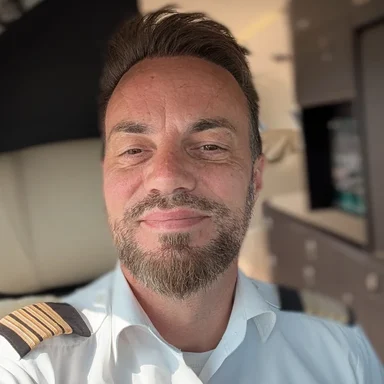
Who writes this guide?
On preparing for the examination, I write wearing two hats: that of the airline pilot who has attended this appointment about twenty times, and that of the former nurse who has performed, on the other side, most of the tests it contains. Two perspectives on the same moment: the one we undergo, and the one we administer.
In brief
Properly preparing for your medical examination is above all being honest on the health questionnaire and bringing the right documents (ID, glasses + prescription, recent medical reports). According to Fabian Voncken, airline pilot (ATPL) and former nurse, the AME is an ally, not an opponent: hidden information discovered later causes far more problems. Avoid alcohol the day before and excess coffee in the morning, this can raise blood pressure and disrupt the reading of the ECG.
The golden rule: the AME is your ally
The candidate's first mistake is to approach the examination as a test to "pass" by hiding what is embarrassing. But the AME is not there to trap you: they certify fitness, and they need an honest picture of your health. An omission discovered later (at a subsequent examination, or worse, after an incident) has far heavier consequences than a point reported from the start, which the AME will know how to manage or refer to the authority.
The pilot's take
Having been a healthcare professional and then a patient-pilot, I say it bluntly: above all, hide nothing from the doctor. First, because it is an illusion: an AME is trained to conduct a comprehensive anamnesis to get a global picture of your condition; what is left unsaid often ends up showing. Secondly, because your aeromedical file follows you from one examination and authority to another, and with the increasing digitization of health data, an omission is increasingly likely to resurface. Finally, if you conceal a disease or treatment and an incident occurs in flight, your insurance may, according to the terms of your contract, turn against you. True hypertension, for example, cannot be hidden, and does not have to be. What is smart, however, is to avoid it flaring up for nothing on D-Day, under the effect of stress or coffee (see below), without ever masking true hypertension.
What to bring
- Valid ID.
- Glasses or contact lenses + their prescription and a spare pair, mandatory on board as soon as a visual limitation appears on the certificate (see the pilot's glasses guide).
- Recent prescriptions and reports if you are undergoing treatment or have had an examination (cardio, ophthalmology...).
- Logbook / license depending on the examination.
- For an initial class 1: book the appointment well in advance (AeMC center), plan for more time and a higher budget.
The 48 hours before: what can skew the results
- Avoid alcohol the day before and excess coffee in the morning: this can skew blood pressure and ECG.
- Sleep well: a short night increases blood pressure and perceived fatigue.
- Do not stop a treatment on your own: the right reflex is to talk to your doctor, and report it to the AME. If in doubt, ask the question before D-Day.
- Report any recent medication or supplement.
The pilot's take, my routine
Honestly, I don't "prepare" for my examination in the strict sense, but I impose a few common-sense rules on myself. The day before: no restaurant, no going out, no alcohol. A normal, quiet day, a little sport, and above all a good night's sleep, no all-nighters in front of a screen, and, for my part, no sleeping pills the day before. The idea is simple: arrive in good shape. Because today it's no longer just the somatic examination: there is also a psychological component, reinforced in recent years, where the doctor is interested in your mental state. Showing up exhausted from a night out does not work in your favor in this area. Last reflex: do not take a medication the day before that you do not usually take, and if you wear glasses, bring them (with the spare pair).
Disclaimer. These are general lifestyle tips, never advice to stop or modify a treatment: if in doubt, talk to your AME or your doctor.
The case of blood pressure ("white coat")
Many candidates see their blood pressure rise in the office simply from stress: the "white coat" effect. This is common and well known to AMEs. A few common-sense reflexes: arrive early to settle down, avoid running just before, breathe calmly, do not stuff yourself with coffee. If the first measurement is high, the AME generally retakes it after a few minutes of rest.
The pilot's take, showing up relaxed, without hiding anything
Let's be clear: the goal is not to camouflage true hypertension, that is impossible and would be dangerous, but to avoid the false positive of stress. A few simple reflexes, from someone who has taken thousands of blood pressures: sleep well the day before and eat properly; hydrate well the day before, this is also appreciated on the day of a blood test; arrive early, so as not to compound the stress of a delay. During the examination: at the moment of the blood pressure check, breathe calmly; for the electrocardiogram, truly relax, so as not to raise your heart rate for nothing. A settled body gives a true measurement, neither better nor worse than reality.
The very first examination: find out beforehand
For a first examination, especially class 1, the most comprehensive, my advice comes down to one word: find out. Know in advance everything that will be done (blood test, urine analysis, ECG, audiogram, visual examination, blood pressure, general examination... and, depending on the case, other tests), simply so as not to be surprised on D-Day. This is the whole purpose of this site: each test is detailed here. Count on at least a day, sometimes more at the initial. And if you know a pilot who has already taken it, talk to them about it: nothing demystifies it better.
D-Day: how it goes
The medical history questionnaire is completed with the doctor, followed by the physical examination and tests directed according to the class. Three possible outcomes: fit, fit with restrictions, or unfit, with, in the latter case, avenues of appeal (see the unfitness and appeal page).
Preparation checklist
| When | What to do | Why |
|---|---|---|
| When booking | Ask for the price; for an initial class 1, book early at an AeMC | Anticipate cost and delay |
| The week before | Gather ID, glasses prescription, reports, prescriptions | Avoid being sent away for a missing document |
| The day before | No alcohol, no going out, no sleeping pills; sleep well; stay well hydrated | Do not skew blood pressure/ECG + be in shape (psy component) + facilitate the blood test |
| D-Day morning | Coffee in moderation; arrive early | Limit the "white coat" effect and the stress of a delay |
| During | Be honest on the questionnaire; report treatments; breathe calmly; glasses + spare | The AME is an ally; an omission costs more; avoid a false positive for stress |
| Ongoing treatment | Talk to your doctor and report it to the AME; do not stop anything on your own | It is the AME's job to take it into account |
| First class 1 | Find out about all the tests; plan for ≥ 1 day | Don't be surprised; demystify |
Informative checklist. It does not replace the instructions of your AME.
Frequently Asked Questions
What must I absolutely bring to my examination?
Should I avoid coffee before the examination?
Do I have to tell the doctor everything, even what might be embarrassing?
Is there a psychological examination?
My blood pressure goes up in the office because of stress, what should I do?
Do I have to stop my treatment before the examination?
How long does the examination take?
To go further
The examination tests vision and hearing in particular. To prepare for these aspects: protecting your hearing in flight and the complete guide to the medical examination (validities, classes, age limits). If an issue arises, the unfitness and appeal page details the avenues of appeal by country. And before all that, you have to find out where to make an appointment: where to take your initial class 1 lists the approved centers and doctors in the four countries.