
2026-27 Edition · France · Belgium · Switzerland · Luxembourg
You have more control
than you think.
The fitness decision is not up to you, and nothing will change that. The rest is: the time you take the examination, the place, the documents you bring, what you mistakenly believe, and what you do if the answer does not go your way.
Written by an airline pilot who has taken this examination about twenty times, and who has performed most of the tests it contains on the other side.
One-time payment · you choose your country before paying · access to the appendix open upon payment
If you haven't signed up for your training yet
Read this paragraph, even if you don't buy anything.
Professional training costs tens of thousands of euros, often paid in advance, and this advance is consumed. The medical examination is the only door that can shut down this project overnight, and it is non-negotiable.
So take it first. Not after signing, not after the first payment, not "when the school asks for it". Before. This is the first sentence of chapter 2 of the guide, and it is the only thing I repeat three times in it, because it is the only one that can save you from losing a five-figure sum.
And if that's all you remember, all the better. This advice costs nothing, requires no medical knowledge, and does not depend on any doctor. It is about the order in which you do two things you were going to do anyway.
The rest of the guide is for what comes next: knowing where to take this examination, what will happen there station by station, what to bring, and what to do if an issue arises. It is useful, but it comes later.
Your examination is further away than you think.
And this is exactly what gets stuck. Most candidates discover the delay when they pick up the phone, which is too late to prepare anything.
months to get an appointment. And nearly a year between the request and receiving the result.
No wait time published, and no reliable benchmark for an initial class 1 at a centre. I am not going to invent one.
No published delay, and no reliable benchmark. I am not going to invent one.
Where do these numbers come from, since you are going to ask me. No country publishes its appointment delays. So they are field benchmarks. The one for Belgium comes from an exchange dated July 23, 2026 with the head of a Belgian school. For Switzerland, I used to put forward an order of magnitude of six months, drawn from field reports I was never able to trace by name. A review in September 2026 found it very long: I have withdrawn it. With an AME in French-speaking Switzerland, a class 2 appointment takes a matter of weeks, and it varies a great deal from one practitioner to another; for an initial class 1 at a centre, I have no reliable benchmark, and I prefer to say so. These are not official data, and the guide says so every time.
But they all tell the same story: by the time you read this page, the date of your examination is probably already written somewhere in the next six to twelve months. Every week spent without preparing your file is a week you will not get back. The price of this guide will not change. What changes is your place in line.
What an examination you discover on the spot costs
The price, twice
An initial class 1 approaches €1,000 in Belgium once all the lines of the grid are added up. An incomplete file means a second appointment, and therefore a second payment.
The slot, lost again
A missed appointment is not made up the following week. It is made up at the end of the queue, six months later, sometimes more.
The order, reversed
The most expensive thing is not the examination: it is having taken it after signing for your training. The guide makes you do the opposite, and that may be all it needs to bring you.
This guide does not make medical problems disappear. It shifts the moment they are discovered, and this shift changes everything, because an issue found at D-90 is handled calmly, while the same issue found at D-0 sends you home without knowing what to do.
What's inside
Six parts, printable tools,
and an appendix that does not expire
The D-90 → D-0 retroplanning
The examination treated as a dated project: what to do, when, in what order. This is the part candidates regret not having had.
The examination from the inside, station by station
What the candidate experiences at each station, what the examiner looks at, avoidable mistakes. The part that I am about the only one who can write.
Complicating cases
History, ongoing treatment, refractive surgery, blood pressure, sleep apnea: how to compile your file and understand the circuit. Reviewed by approved aeromedical examiners.
If things go wrong
Referral to the authority, fitness with limitations, appeals: your rights, deadlines, procedures. Without selling hope and without dramatizing.
The appendix for your country, plus microlights
Who examines, where, with what forms, what costs observed, what course of action in case of referral. Plus the microlight regime, which is completely different from one country to another.
Detachable tools
The printable retroplanning, the "my questions for the AME" sheet to take out during the consultation, and the template for requesting access to your medical file.
The full table of contents
122 to 125 pages depending on the edition
A5 format, to read on a phone or print. Here is what is inside, chapter by chapter.
Before you begin
Read this first
What "passing" means here, and what this guide is not. Who writes it. How it is structured, and how it is maintained.
Chapter 1
The system, in ten pages
The three certificates and the license to which each is attached. Who examines what, between the center and the AME. The validity periods according to age and class, including the two ceilings of class 2 that almost no one knows about. The difference between revalidation and renewal, and what it costs when you discover it too late. What you must report between two examinations. What happens when a file goes to the authority. The recognition of your certificate in other European countries.
Chapter 2
The retroplanning, from D-90 to D-Day
The principle that governs everything else: the examination before the training costs. Then four dated steps. At D-90, decide and book, knowing that the countdown does not start when you call but when you have a date. At D-60, compile the file. At D-30, lock it down. At D-7, finalize. The last 72 hours. And the day itself.
Chapter 3 · the longest, nearly half of the guide
The examination from the inside, station by station
What changes between an initial examination and a revalidation. The medical history questionnaire. The mental health component, and the airline psychological assessment that is always confused with it, even though it does not concern the student pilot, the private pilot, or the flying club instructor. What happens to your license when a treatment is proposed to you, in seven steps. Blood pressure and the white coat effect. The electrocardiogram, including the conclusion line at the bottom of the tracing. The audiogram, and why it is not annual contrary to what many believe. Vision, glasses, and color vision, where failing the first test is not the end. Blood and urine tests. The electroencephalogram. The three possible outcomes upon leaving. And who pays, in your country.
Each station follows the same format: what the examiner looks at, avoidable mistakes, and the question to ask beforehand.
Chapter 4 · reviewed by approved aeromedical examiners
Complicating cases
The question the authority really asks itself when faced with a file. The common circuit: referral, consultation, limitations. Why telling everything protects you, with mechanics and not morality. Then six situations treated one by one: a banal history, an ongoing treatment, eye surgery, blood pressure discovered on the day, sleep apnea, diabetes. And what changes in class 2 and LAPL.
Chapter 5
If things go wrong
First of all, precisely naming what is happening to you, because referral, temporary unfitness and unfitness are not the same thing and do not open the same doors. Your rights as a holder. The reflex that changes everything, noting the date. The appeal circuit in your country, with its deadlines. The procedure to follow in five steps, with the two calendar reminders to set upon notification. The transfer of a file from one authority to another. And the financial aspect, including loss of license insurance.
Chapter 6 · specific to your country
The appendix for your country, and microlights
Your authority, where to take your initial class 1, what changes in class 2 and LAPL, the official lists, and a table of changing data, each with its verification date. Orders of magnitude to read a quote without being surprised. The check to make before leaving the examiner's office: what is written on your certificate. And the microlight regime, which is completely different from one country to another.
References
Where each statement comes from
The subject-by-subject table of the European text, the national references, your right of access to your own medical file. And a list of outdated texts still circulating, each with what you need to know to spot it. Chapter 3 also provides a simple test to sort your sources: seeing the reference a page cites is often enough to know if it has been updated.
To print
Four detachable tools, one page each
The checklist of documents to bring. The retroplanning to fill out, with your three dates. The "my questions for the AME" sheet, to take out during the consultation. And the template letter to request your medical file, already drafted, with the correct legal basis according to your country.
Why you can take my word for it
or rather, why you don't have to
Four approved aeromedical examiners reviewed and corrected it
The chapter on complicating cases was reviewed by Dr Frédéric Loock, Class 2 certified examiner, who enriched it with his practice: from trivial medical history forgotten in good faith to sleep apnoea. Dr Sébastien Bisconte, aeromedical examiner, reviewed the site and gave me thirty-seven comments on regulatory vocabulary, periodicities and thresholds, then he took up this same chapter three days later and gave me twenty-two more. And when one of their remarks diverged from the regulation, I went to check the text before applying it, twice, the text decided. Dr Marc-André Polet, approved aeromedical examiner (AME EASA B-AME 1015, ENT, Belgium), took up this same chapter in August and completed it on nine points, including eye surgery and the follow-up required when a treatment is in place. And Dr med. Jérôme Dällenbach, Aeromedical Examiner (AME) OFAC, Médecine interne générale FMH, 1700 Fribourg (Switzerland), reviewed and validated the Swiss section in September 2026. All four gave their written agreement to be named.
No invented value. Never.
In the guide, each figure bears its verification date. When a data point does not exist publicly (a price, a deadline) the guide writes that it does not exist, instead of fabricating a credible order of magnitude. It sells less well, and it is the only way to be useful.
Your copy bears your name
No technical lock, no app to install, no proprietary reader: an ordinary PDF, simply yours. You read it on your phone, you print it, you annotate it.
A preview before you buy
The cover, the complete table of contents, and the first pages. You see what you are buying looks like.
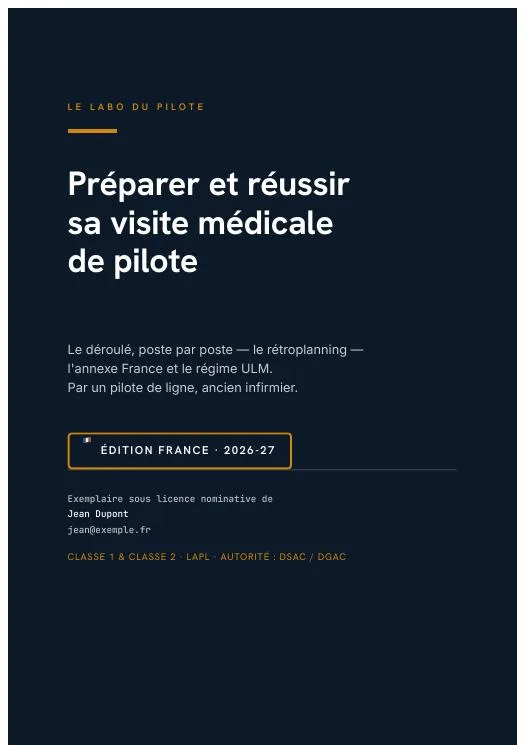
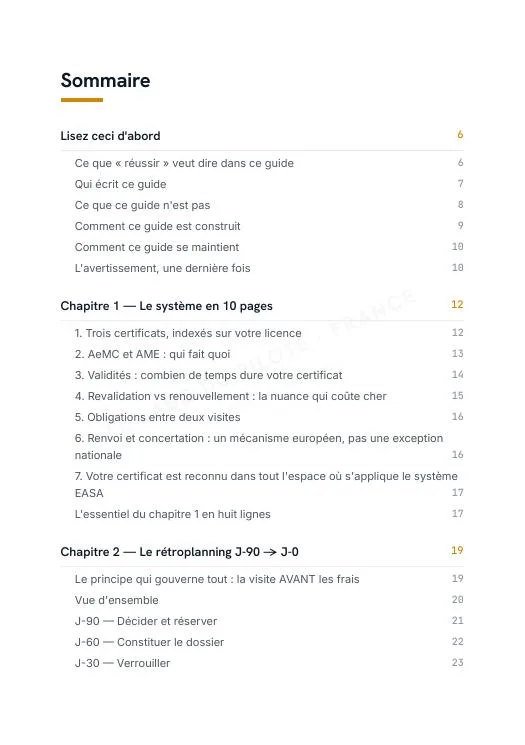
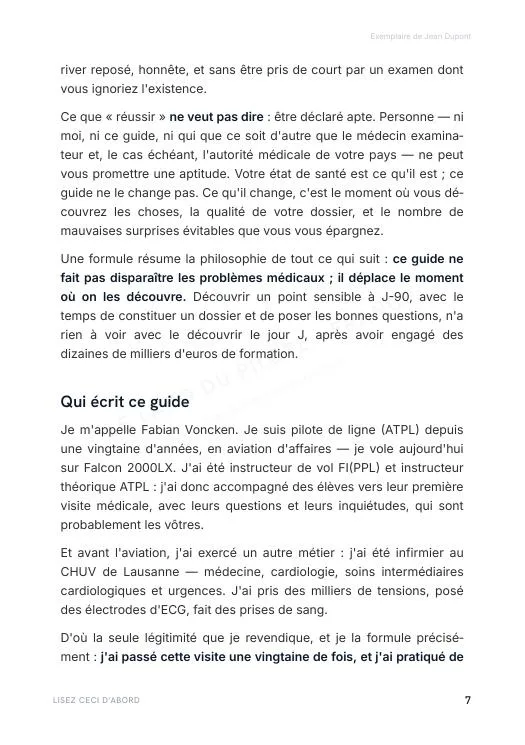
Nominative copy, in your name, received by email right after payment.
The guide, 2026-27 edition
One-off payment. No subscription, no renewal.
One price, the same for everyone, with no countdowns or quotas.
- The complete guide in PDF, 122 to 125 pages depending on the edition, Class 1 and Class 2
- The complete appendix for the country of your choice France, Belgium, Switzerland or Luxembourg, which you choose before paying
- Detachable tools to print
- Twelve months of online appendix: costs, centres, deadlines, regulatory changelog, reviewed four times a year
- Updates to your edition during these twelve months
To contextualise this price: the examination itself approaches €1,000 in Belgium once all the lines are added up. An incomplete file on D-Day makes it two, plus a lost slot that has to be caught up at the end of a queue of several months. The guide costs €59, once, and it is made so that this does not happen.
The country where you take your examination
Your copy contains the complete appendix for this country: who examines, where, with what forms, what costs observed, and the microlight regime. The European foundation is the same in all four editions.
Credit card, Apple Pay and the local payment methods of your country · 21% Belgian VAT already included in the €59 · secure payment by Stripe
Before you buy, what this guide is not
I prefer to tell you now rather than later. I am not a doctor: I am an airline pilot and a former nurse. You will therefore not find here any fitness prognosis, in any form, not even reassuring. No opinion on your case. No interpretation of your results. No treatment advice. And no trick to hide anything from your doctor: the longest chapter of the guide explains exactly why concealment is the only choice that can truly destroy a career.
"Passing", in the title, means arriving prepared: at the right place, at the right time, with the right documents, knowing what is going to happen. Not being declared fit. That, no one can promise you, neither me, nor this guide, nor anyone except the aeromedical examiner.
A question about what the guide covers before paying? Write to me I answer myself.
Questions people ask me
How do I receive the guide?
I am taking a class 2, not a class 1. Is it useful?
Why only one country?
Why pay when part of the site is open access?
And when the regulations change?
This guide is an information and preparation document. It does not replace a consultation with an aeromedical examiner (AME), nor the regulations in force, nor the instructions of the authority of your country. If in doubt about your personal health situation, only one address: an AME. The terms of sale detail the price, VAT, delivery, right of withdrawal and refunds.
You will take it anyway
The only question is whether you get there knowing what to expect, or if you discover it in the room. Both cost the same appointment price. Only one of the two leaves you in control of what happens there.
I gave you the most expensive advice in this guide earlier, for free: take the examination before signing. It alone is worth tens of thousands of euros, and it costs you nothing. The rest of the guide is for what comes after, and that I cannot write on a web page.
Delivery by email in a few minutes · a question before buying, write to me, I answer myself.