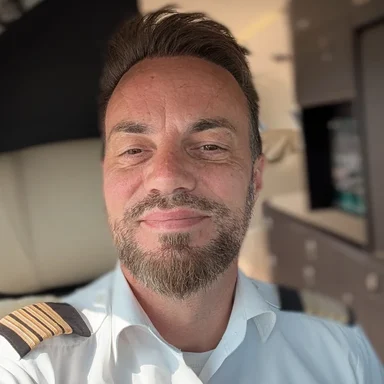
Who writes this guide?
I have been an airline pilot (ATPL) for ~20 years (business aviation, Falcon 2000LX). I have taken this examination about twenty times, and I have practised most of the tests it contains from the other side. Before aviation, I was a nurse for several years in cardiology, intermediate cardio care, and emergencies at the CHUV in Lausanne. Pilot and former healthcare professional, not a doctor: this guide informs, it does not make any diagnosis and does not judge any medical fitness. This guide is not a compilation: it is what I would have liked to read before my first aeromedical examination.
In short
The aeromedical examination verifies that your health is compatible with flying. Three EASA certificates depending on the target licence: Class 1 (professional pilot, CPL, MPL, ATPL), Class 2 (private pilot, PPL), LAPL (leisure, light aircraft). The initial issue of a Class 1 must be done at an authorised aeromedical centre (AeMC); Class 2 and LAPL with an aeromedical examiner (AME). Period of validity from 6 to 60 months depending on age limit and class. Microlights follow a distinct regime.
Which certificate for which licence?
The medical certificate is not a single examination: it is linked to the licence you are aiming for. The broader the privileges (passenger transport, commercial flight), the higher the medical standard.
| Certificate | Target licence | Who can examine? | Initial issue |
|---|---|---|---|
| Class 1 | CPL, MPL, ATPL (professional licences) | AeMC; revalidation and renewal at an AeMC or with an AME | AeMC mandatory |
| Class 2 | PPL aeroplane, helicopter, sailplane, balloon | AeMC or AME | AeMC or AME |
| LAPL | LAPL (leisure, light aircraft) | AeMC, AME, and depending on the country an authorised general practitioner | AeMC or AME |
Source: EASA Part-MED, Annex IV to Regulation (EU) 1178/2011. Class 1 includes the privileges of Class 2 and LAPL; Class 2 includes those of the LAPL. If you hold a valid Class 1, you therefore do not need a separate certificate to fly privately.
Validity: how long does my certificate last?
This is the most frequently asked question on forums, and the source of costly mistakes. The durations depend on your age on the day of the examination and the class. Figures from the EASA Part-MED regulatory text (MED.A.045).
| Age limit | Class 1 | Class 2 | LAPL |
|---|---|---|---|
| < 40 years | 12 months | 60 months* | 60 months* |
| 40 to 50 years | 12 months | 24 months | 24 months |
| 50 to 60 years | 12 months | 12 months | 24 months |
| ≥ 60 years | 6 months | 12 months | 24 months |
* A Class 2 or LAPL certificate issued before the age of 40 ceases to be valid once the age of 42 is reached (the 60-month duration is therefore "capped" at the 42nd birthday).
Two age limits cut the displayed validity, without anything on the certificate announcing it. A Class 2 certificate issued before the age of 40 ceases to be valid on the 42nd birthday; issued before 50, it ceases to be valid on the 51st birthday (MED.A.045 a)3)). A LAPL certificate issued before 40 ceases to be valid on the 42nd birthday (MED.A.045 a)4)i)). Beyond 40, the LAPL validity remains 24 months (MED.A.045 a)4)ii)): unlike Class 2, the LAPL has no age limit at the 51st birthday. In concrete terms: a Class 2 taken at 49 years and 11 months displays 24 months, but expires on the 51st birthday.
Class 1: the validity remains 12 months up to 60 years: the 40 and 50-year age limits in the table above concern Class 2 and LAPL, not Class 1. It drops to 6 months for pilots engaged in single-pilot commercial air transport operations carrying passengers (single-pilot in public transport, in everyday language) who have reached 40 years of age, and for everyone from 60 years of age.
Revalidation or renewal: the nuance that costs dearly
The same principles of revalidation (within the 45-day period preceding expiry) and renewal (outside this window, thus before or after) apply:
Examination before expiry, within the 45-day period: you keep your anniversary date. The period of validity starts from the expiry date of the previous certificate.
Examination outside the 45-day period, thus too early or too late: the new validity starts from the date of the examination, you lose your original anniversary date.
The renewal examination repeats the requirements of the initial issue, as comprehensive as an initial issue examination (details below).
What separates a revalidation from a renewal is not the length of the expiry: it is the 45-day period (MED.A.045 b) and c)1)). The thresholds (less than 2 years, from 2 to 5 years, more than 5 years) intervene within the renewal and determine the content of the examination (MED.A.045 c)2)).
The 45-day period cuts both ways. An examination taken within the 45-day period preceding expiry revalidates the certificate from the expiry date (MED.A.045 b) and a)5)). Taken earlier, it falls outside this window: the examination switches to a renewal (MED.A.045 c)1)) and the new validity starts from the examination date. The cautious pilot who does it three months beforehand gives themselves three months less.
A renewal, including after more than five years of expiry, can be carried out by an AeMC or by an AME, for Class 1 as well as Class 2 (MED.A.040 c)1)). One exception: in Class 1, holders who have reached 60 years of age and are engaged in single-pilot HEMS (Helicopter Emergency Medical Service) generally fall under an AeMC. Past five years of expiry of the certificate and not five years since the last examination, the confusion is frequent, the examination requirements of the initial issue apply (MED.A.045 c)2) iii)): the examination is as comprehensive as an initial issue examination, but the regulation does not impose the centre. In practice, some AMEs prefer to refer to an AeMC: check with yours.
Between two examinations: when your medical fitness may cease
Between two examinations, your medical fitness may cease without any paper indicating it. MED.A.020 a): you shall not exercise the privileges of your licence at any time if you are aware of any decrease in your medical fitness, if you take any prescribed or non-prescribed medication, or if you receive any medical, surgical or other treatment. MED.A.020 b): you must seek aeromedical advice without undue delay and before exercising the privileges in the event of a surgical operation or invasive procedure, the regular use of medication, a significant personal injury, a significant illness, pregnancy, admission to a hospital or medical clinic, or the need for correcting lenses for the first time.
How does the examination take place?
The examination is a general medical check-up enhanced with "flight factor" oriented tests. For a Class 2 / LAPL, generally allow one hour. The doctor begins with a medical history questionnaire that you fill out together, then performs a physical examination.
Typical examinations (Class 2 / LAPL): check for abnormalities in the eyes and ears, heart, lungs, abdomen, and limbs; mobility, balance, and coordination; and, if necessary, additional tests such as a blood test or an ECG.
In Class 2, the urine test, vision examination, and hearing test are mandatory at every examination MED.B.035 a): "Each aeromedical examination shall include a urine test." MED.B.080 a)1): "The hearing of the applicant shall be tested at all examinations." MED.B.070 a)2) i): standard ophthalmological examination at the initial issue examination and at all revalidation and renewal examinations. The regime "where the doctor deems it necessary" does exist, but it is specific to the LAPL (MED.B.095 d)).
Not to be confused: in Class 2, this "hearing test" is conversational the doctor checks that you can hear a normal voice. Pure-tone audiometry (the "audiogram" itself) is only required if you hold or are aiming for an instrument rating (IR/BIR); in Class 1, it is systematic (MED.B.080). Its periodicity is set by the text: at the initial issue examination, then every 5 years up to 40 years, every 2 years up to 60 years, and annually thereafter (MED.B.080 a)1) i)): the same rule applies to Class 2 combined with an IR/BIR rating.
For the LAPL, the standard is deliberately lighter: clinical examination, blood pressure measurement, urine test, vision and hearing assessment at the initial issue examination; re-evaluations for those under 50 can be lighter and focus on the medical history.
Three possible outcomes to the examination:
Fit
Fit with limitation(s)
Wearing of glasses mandatory, day flight only, reduced validity, presence of a qualified co-pilot...
Unfit
In which case the file may be referred to the licensing authority for review.
Where to take your examination, and who decides? (Belgium, France, Switzerland, Luxembourg)
The EASA certificate is the same everywhere, but each country has its own authority, its centres, and its official list of authorised aeromedical examiners. This is precisely where French-speaking pilots get lost, here is the circuit for the four countries. In all cases, the safest reflex is to start from the official list of your national authority (link in the sources at the bottom of the page): the authorised doctors are listed there, up to date.
Belgium
The circuit is steered by the SPF Mobility and Transport, Civil Aviation Authority; the Aeromedical Section (AMS) is the licensing authority that oversees medical matters and decides on disputed cases.
- Class 2 / LAPL: with an AME (authorised aeromedical examiner) or an AeMC. The initial issue examination can be done directly with an AME.
- Initial Class 1: mandatorily in an AeMC. Two centres publish their pricing in Brussels (the CEMA (aeromedical expertise centre of Medex, SPF Public Health, place Victor Horta 40/10, 1060 Brussels) and the CMA (Defence, Queen Astrid Military Hospital, rue Bruyn 1, 1120 Brussels) Neder-over-Heembeek district). Belgium has three approved AeMCs, all authorised for Class 1, the third being Attentia Aviation Medical in Zaventem (DGTA list of 01/07/2026).
- Particularity to know: there is a Class 4, "Belgo-Belgian", not internationally recognised (non-ICAO), its criteria are very close to Class 2, the examination is done with the same doctor and at the same price. If you intend to fly outside Belgium, you might as well aim directly for Class 2.
- Appeal: if a criterion is not met, the AME cannot issue the certificate, but the AMS can review the case (quick and free review in the first instance); in the second instance, the Appeal Commission.
France
The licensing authority is the Pôle Médical du Personnel Navigant, within the DSAC (DGAC). It approves and oversees AMEs and AeMCs, makes fitness decisions in the "referral" procedure, and checks foreign aeromedical examinations.
- Class 2 / LAPL: with a DGAC-approved AME or an AeMC. The DGAC publishes an official list of Class 2 authorised doctors, sorted by postcode (PDF updated regularly) as well as a Class 1 list.
- Initial Class 1: in an AeMC. The European regulation only knows this term; in France, these centres are called CEMPN, centres of medical expertise for flight crew.
- Class 1 revalidation / renewal: contrary to a widespread idea, they are not reserved for CEMPNs: a Class 1 approved AME can carry them out (MED.A.040 c)1)). Only the initial admission is mandatorily done in a CEMPN.
- The LAPL is not a lightened Class 2 by national tolerance: it is a distinct regime of the regulation (MED.B.095). The initial assessment, the re-evaluations after 50 years and those done without access to the medical history include at least: clinical examination, blood pressure, urine test, vision, hearing capacity. After the initial assessment and up to 50 years, re-evaluations include at least an assessment of the medical history, and the other elements where the doctor deems it necessary.
- Appeal: in case of medical unfitness, review by the Pôle Médical, then the possibility of seizing the Medical Council of Civil Aviation (CMAC).
Switzerland
The licensing authority is the FOCA Aeromedical Section (AMS). It oversees medical control, manages centres (AeMC) and medical examiners (AME). If you disagree with an AME's decision, you may ask for a review within 30 days: in practice it is carried out by the FOCA chief medical officer, and so remains internal to the authority. The next instance is the Federal Administrative Court directly, again within 30 days (full route on the page devoted to refusal and appeal).
- Class 2 / LAPL: with a FOCA-approved medical examiner (AME) or an AeMC. FOCA publishes the official list of medical examiners.
- Initial Class 1: in an approved centre (AeMC). ⚠️ For an initial class 1, the eye examination is carried out by an expert approved by the FOCA, and it is not done at the centre: it is a separate consultation, to be booked in addition to the AeMC appointment, before or after the visit to the centre. It is necessary for the initial class 1 to be established. For revalidations and renewals, the expert is consulted only if your AME refers you. Ask the centre how to arrange it when you book. Switzerland has only two AeMCs, both in German-speaking Switzerland: the Fliegerärztliches Institut in Dübendorf (ZH) and the Swiss Medical Services in Kloten (Zurich-Airport); none in French-speaking Switzerland. A French-speaking candidate must therefore travel across the Sarine for their initial issue examination, to be integrated into your deadlines. The renewal can then be done with a medical examiner (AME), including in the French-speaking region.
- Practical note for French-speaking Switzerland: it is indeed the first examination, and only that one, which requires travelling across the Sarine. Geneva and Nyon lost their AeMC accreditation, but for subsequent examinations you stay in French-speaking Switzerland: 19 AMEs practise there, a count made on 16/09/2026 on the FOCA's public list. If you travel up to Dübendorf or Kloten, all the doctors there speak English and some speak French: ask when you book.
Luxembourg
The licensing authority is the Directorate of Civil Aviation (DAC), via its Aeromedical Service. The DAC publishes the list of Part-MED certified AMEs, as well as doctors for microlight pilots and parachutists.
- Class 2 / LAPL: with a certified AME appearing on the DAC list, or an AeMC.
- Initial Class 1: in an AeMC.
- Good to know: the DAC accepts examiners certified by any EASA Member State, and licensing procedures largely go through the MyGuichet.lu platform. Given the size of the country, many Luxembourg pilots also take their examination in a neighbouring country, which has no impact since the EASA certificate is recognised everywhere (see the FAQ).
How much does it cost?
The examination is not reimbursed by health insurance: it is a cost to anticipate. Observed orders of magnitude (to be confirmed on a case-by-case basis with the practitioner, fees are free):
| Type | Observed range |
|---|---|
| Microlight certificate of non-contraindication | ~€25 to €40 |
| Class 2 / LAPL | ~€50 to €100 |
| Class 1 (initial issue) | €460 to €1,180 depending on the centre |
As an example in France, one authorised doctor charges €55 for a Class 2 or LAPL examination and €40 for a certificate of non-contraindication, other practitioners charging between €70 and €90; other sources place Class 2 rather around €70-100. In Belgium, some AMEs apply a fixed price per examination regardless of the class, including all standard tests carried out in the practice: any external tests remain separate. In Switzerland, no prices are published: ask the centre for a quote.
What about microlights? A separate regime, varying by country
It is a constant source of confusion, and the framework is not the same from one French-speaking country to another, hence the value of a European point of view that American websites cannot give you. A transversal rule emerges: the microlight medical becomes stricter as you go from France to Switzerland, from "any doctor" to "mandatory AME".
| Country | Medical required (private use) | Who examines it | Strictness |
|---|---|---|---|
| 🇫🇷 France | CMNCI, FFPLUM federal requirement, not a state obligation | Any doctor (including family doctor) | The lightest |
| 🇱🇺 Luxembourg | Part-MED (EASA) or national certificate | Depending on the route | Intermediate |
| 🇧🇪 Belgium | Class 1, 2 or LAPL (microlight); class 4/2/1 (paramotor) | AME mandatory | Strict |
| 🇨🇭 Switzerland | LAPL or Class 2 (Ecolight only) | AME | The strictest |
- France: the lightest. Microlights do not fall under the EASA aeromedical examination. In France, no regulatory text imposes a medical certificate for the microlight pilot licence and certificate in private flying. The amended order of 31 July 1981, which sets these conditions in its §4.5, contains none, and its §2.3, devoted to physical and mental fitness, ends with: "None of the terms of this paragraph concerns the microlight pilot licence." The certificate of non-contraindication (CMNCI) known to French microlight pilots is a condition of the FFPLUM federal licence, not a State obligation. Commercial activity, however, is regulated. The "OPS-ULM" order of 17 February 2025 requires, for carrying a person on board for remuneration (§7.7.7) as for local commercial flights (§5.2.2 c)), that a pilot aged 40 or over holds a medical certificate of absence of contraindication to the practice of a commercial activity in a microlight, or one of the certificates of Regulation (EU) No 1178/2011. Since the order of 16 March 2026 (in force on 1 April 2026), the validity grid is in Appendix C, III: less than five years if the pilot is under 60; less than two years if under 70; less than one year from 70. Appendix C, I specifies that this examination is carried out by any medical doctor. Good to know: the microlight certificate, once obtained, is permanent. The "valid 24 months" sometimes read concerns the theoretical certificate (time limit to obtain the certificate after the written exam), not the certificate itself: a frequent confusion that we take care not to reproduce.
- Belgium, stricter than in France. To fly a microlight, you must demonstrate your fitness to an authorised aeromedical examiner (AME) and hold a Class 1, 2 or LAPL certificate. Paramotoring requires a national Class 4, or a European Class 1/2. The Belgian microlight therefore does not escape the aeromedical examiner, unlike the French microlight. (Source: DGTA / mobilit.belgium.be, microlight and paramotor medical certificate pages.)
- Luxembourg: a national route. The DAC issues a national microlight licence; the accepted medical is a Part-MED (EASA) or national certificate. Microlights therefore have their own medical route, distinct from Part-MED AMEs alone. (Source: DAC / guichet.public.lu.)
- Switzerland: the most demanding, and no true light microlight regime. "Classic" microlights remain outside the national framework; only Ecolights registered HB can fly, under a Swiss UL licence (backed by EASA licences) with a LAPL or Class 2 level medical, issued by an AME. Foreign microlights only enter Swiss airspace with a special permission (AIC 003/2022; official FOCA list of admitted types). In Switzerland, you are therefore at the EASA licence level, not a lightened microlight level. (Source: FOCA/BAZL.)
Preparing for your examination: the checklist
Practical common-sense advice, confirmed by practitioners:
-
01
Be honest on the medical questionnaire. The doctor is your ally, not your opponent: an omission discovered later is much more problematic.
-
02
Bring your documents: ID, glasses/lenses + their prescription, prescriptions and recent test results if you are undergoing treatment.
-
03
Avoid alcohol the day before and excessive coffee in the morning: it can distort blood pressure and ECG.
-
04
Report any medication or supplement taken recently. Some treatments can influence blood pressure, ECG tracing, or urine tests. The right reflex is not to stop a treatment on your own before the examination, but to talk to the AME about it: it is precisely their job to take it into account. If in doubt about a regular treatment, ask the question before D-day.
-
05
For an initial Class 1, anticipate: make an appointment several weeks in advance and do it before committing to significant training costs.
(Detailed guide in the "Preparing for your medical examination" sub-page.)
Frequently asked questions
Is wearing glasses an obstacle?
From what age can you take the examination?
Is my certificate valid in other French-speaking countries?
Can I take my examination in a neighbouring country?
Do microlights require the same examination as the PPL?
What happens if I am declared unfit?
The most expensive part is not the examination
It's having taken it after signing up for your training. An initial Class 1 approaches €1,000 in Belgium once all the additional lines are added up, an incomplete file doubles it, and the lost slot can be caught up at the end of a queue of several months.
The guide puts things back in order: the examination before the training costs, the dated reverse schedule, the station-by-station process, and what to do if things go wrong.
See the guide, €59To go further
Health hub sub-pages
- Medical unfitness: appeals and procedures
- Hypertension, diabetes and fitness: what the European text says
- Hypoxia and carbon monoxide: invisible dangers
- Decoding your audiogram: reading your tracing
- Colour blindness and colour vision: the Ishihara test
- Where to take your initial Class 1: approved centres
Bridges to equipment
Available- The pilot's hearing → protecting your ears in flight