In short
Yes. The initial class 1 is taken at an approved aeromedical centre (AeMC), and one in another EASA state will do: the certificate is recognised in all 31 EASA Member States, Switzerland included. What to settle before booking: the licensing authority recorded on your application, because that authority receives your medical file.
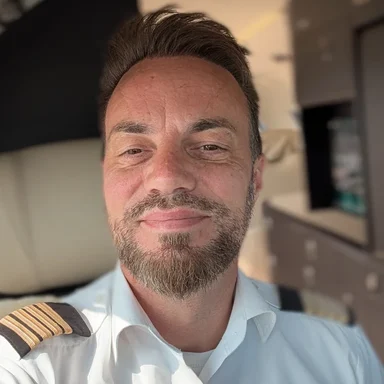
Who writes this page?
I have undergone this medical examination about twenty times, and I have performed from the other side most of the tests it contains. This page is not about prices or waiting times: it explains what the European regulation says when the examination takes place in a country other than the one you will fly from. Every rule quoted here was read in the consolidated text of Regulation (EU) 1178/2011, and what I could not find is stated as such. I do not assess anyone's fitness: the AME, the aeromedical examiner, decides.
What the European regulation says
Three provisions are enough to understand the situation. The first sets the place: “Class 1 medical certificates shall be issued by an AeMC” (MED.A.040(b)(1)). It does not say in which country. EASA confirms in its FAQ that the initial class 1 can only be taken at an AeMC certified for class 1. And a valid certificate issued in an EASA state is recognised by all Member States without any validation step.
The second says who oversees the centre: the authority of the state where it has its principal place of business (MED.A.001(a)(1)). A centre in Madrid or Milan therefore reports to the Spanish or Italian authority, not to the DGAC, the DGTA, FOCA or the DAC.
The third concerns your file: the licensing authority. The regulation defines it as “the competent authority of the Member State that issued the licence, or to which a person applies for the issuance of a licence” and, where no licence has been applied for yet, as the authority determined under FCL.001 (MED.A.010). FCL.001 points to the authority “to whom a person applies for the issue of pilot licences”.
So the country of the centre and the country of your file can differ. The certificate shows the “State where the pilot licence has been issued or applied for”, and its number starts with that state's country code (ARA.MED.130(a)(1) and (3)). Once the examination is over, the centre sends its detailed report without delay, with a copy of the application form, the examination form and the certificate, to that authority's medical assessor (MED.A.025(b)(4)). For class 1, your basic data are also entered in the European aeromedical repository run by EASA (ARA.MED.160).
What I could not find. I found no official text saying which authority a foreign centre records for a candidate who has not yet applied for any licence, and who sometimes has not chosen a school yet. The definition refers to the authority “to which” you will apply for the licence, which assumes you already know. The reliable answer is the centre's, in writing, before the appointment.
Country of examination, authority, file: the table
In every case, the centre is approved by the authority of its own country, and your file goes to the licensing authority recorded on your application. What changes from one row to the next is the list to check and what each authority publishes about transfers. On a phone, scroll the table to the right.
| Country of examination | Centre approved by | Official list | What happens to the file |
|---|---|---|---|
| 🇪🇸 Spain | Spanish AESA (Agencia Estatal de Seguridad Aérea) | List of accredited centres, last modified 13/10/2026: 14 centres. Bilbao comes up often on forums: no centre on the list is located in Bilbao itself, the only one in the Basque Country is in Erandio (Biscay). | Report sent to the licensing authority recorded. If that is the Spanish AESA, the file stays in Spain until you apply for a change of competent authority. |
| 🇮🇹 Italy | ENAC (Ente Nazionale per l'Aviazione Civile) | AeMC list, file dated 03/09/2026. ENAC writes that the initial class 1 is taken “esclusivamente” at an aeromedical centre. | Same mechanism: the file goes to the licensing authority recorded. |
| 🇵🇹 Portugal | ANAC (Autoridade Nacional da Aviação Civil) | The only list I found on anac.pt dates from July 2020. Ask ANAC for the current list before booking. | Same mechanism. |
| 🇷🇴 Romania | AACR (Autoritatea Aeronautică Civilă Română) | I could not verify an up-to-date list on the AACR aviation medicine page. | Same mechanism. |
| 🇫🇷 France (Belgian, Swiss or Luxembourg candidate) | DGAC | Aeromedical fitness page, updated 16/10/2026, AeMC directory version of 21/09/2026. | The DGAC Medical Unit's tasks include checking medical examinations carried out abroad and sending medical files to and from other countries when licences are transferred. |
| 🇨🇭 Switzerland | FOCA (Federal Office of Civil Aviation) | AeMC and AME search on the FOCA website. | For a transfer to Switzerland: SOLI form validated by the medical assessor of the current authority, FOCA review that “may take several weeks” (document of 06/01/2026). |
| 🇧🇪 Belgium | DGTA (FPS Mobility and Transport) | List of medical centres (AeMC). | The DGTA publishes a licence transfer page, whose content I could not read on 25/10/2026. |
| 🇱🇺 Luxembourg | DAC (Directorate of Civil Aviation) | List of aeromedical centres and approved doctors, page modified 12/08/2026. | I found no DAC page on transferring the medical file. |
Lists and pages consulted between 13/10/2026 and 25/10/2026. A centre can lose or gain its approval: the list of the day is the reference. Centres, published costs and waiting times in the four French-speaking countries are on where to take your initial class 1.
Switzerland: outside the European Union, inside EASA
Switzerland is not a member of the European Union. It is nevertheless one of the 31 EASA Member States, which the Agency lists as the 27 EU states plus Iceland, Liechtenstein, Norway and Switzerland. The legal link is a bilateral air transport agreement (FOCA page in French) binding Switzerland and the EU since June 2002. Its annex lists the EU acts Switzerland applies, and a Switzerland-EU joint committee regularly adds new regulations to it. FOCA is the Swiss competent authority, and its document on transferring an EASA medical certificate to Switzerland lists Regulation (EU) 1178/2011 among its references.
What FOCA publishes on transferring a medical file to Switzerland (document of 06/01/2026, available from the change of competent authority page):
- the applicant sends the SOLI (State Of Licence Issue) form to the aeromedical section of the current authority, which validates the medical history, the files and the validity of the certificate;
- FOCA does not accept a form that has not been validated by that authority's medical assessor;
- documents must be in English, German, French or Italian;
- a certificate that is no longer valid must first be renewed by the current authority, and more than five years after expiry an initial examination is required;
- FOCA may request any further information, and warns that the review may take several weeks.
For a Swiss candidate taking the initial in another state, the logic is the same in reverse: if the authority recorded is the one of the centre's country, a change of competent authority to FOCA will be needed later.
Before booking, check
- The centre is on the current official list of its country's authority, with class 1 privileges for the initial. Not on a list copied from a forum.
- The licensing authority that will be recorded on your application and on the certificate, with the country code that will start its number. Ask for it in writing.
- The country where you will apply for your licence. If you already know it, tell the centre: that is the country the regulation's definition refers to.
- The language. The centre must “ensure that communication with the applicant can be established without language barriers” (MED.A.025(a)(1)). Ask which language is used for the interview, the questionnaires and the comprehensive mental health assessment required at the initial class 1 (MED.B.055(a)). The certificate itself is issued in the national language(s) and in English (ARA.MED.130(c)).
- Your medical reports. Ask whether the centre accepts them in French or wants a translation.
- Your previous applications. An examination started elsewhere, a refusal, a suspension: these must be declared, with the examiner's identity and the results (MED.A.035(b)(2)). And you may hold only one medical certificate at a time (MED.A.030(f)).
- Referral. If a point in your file has to be decided by the authority, the licensing authority's medical assessor decides (ARA.MED.125). How a referral unfolds is explained on referral to the licensing authority. Ask the centre how it would work from abroad, and in which language.
After the initial: later examinations and change of authority
Later class 1 examinations are done by an AeMC or an AME (MED.A.040(c)(1)), and you do not have to go back to the country of the initial. At each examination, bring your last certificate (MED.A.035(c)). Worth knowing: the doctor at home sends the report to the licensing authority recorded, which is not necessarily the one of their own country (MED.A.025(b)(4)). As long as your file is in Spain, Spain receives the reports.
To fly on a PPL, the text requires “at least” a valid class 2 certificate (MED.A.030(c)(2)): a valid class 1 meets that condition, and you do not hold two certificates.
Bringing your file home
The regulation covers this. A licence holder may apply to another state's authority for a change of competent authority, and holders of a medical certificate “who do not yet hold a pilot licence” may do so for their medical records too (FCL.015(e)). You apply to the authority that will take you on. It asks the current authority to transfer copies of the medical records and a summary of the relevant medical history verified and signed by the medical assessor (ARA.GEN.360(a) and (e)). The transferring authority keeps the originals, and remains responsible for your certificate until the new authority has issued its own (ARA.GEN.360(b) and (d)).
EASA's acceptable means of compliance list what is sent, including the most recent aeromedical report, the most recent ECG, eye and ENT reports, the initial examination file and the mental health assessment (AMC1 ARA.GEN.360(a)). The regulation asks for action “without delay” but sets no figure. On the Swiss side, FOCA warns that its review may take several weeks.
The pilot's view: three mix-ups to avoid
Mixing up the centre's country and the file's country. The foreign centre does the examination, the licensing authority keeps the file. Two different questions, to be asked separately.
Thinking a renewal at home brings the file back. An AME in your country can renew, but the report goes to the authority recorded. To move the file, the regulation provides for an application for a change of competent authority.
Changing plans along the way without thinking about it. If you choose your school, and so your licence country, after the initial, your file will have to follow. Better to know that before booking the flight.
Frequently asked questions
Can I take my initial class 1 in Spain, in Bilbao for example?
Is a certificate obtained abroad valid at home?
Who keeps my medical file?
Can I renew later with an AME in my own country?
How do I bring my file back to my country?
Does Switzerland apply the same rules?
Do I need to speak the local language?
Further reading
Centres, published costs and waiting times in France, Belgium, Switzerland and Luxembourg: where to take your initial class 1. Classes and validity: the pilot medical examination. If something goes wrong: unfitness and appeal.
The examination itself, station by station, is covered in the pilot medical guide (paid, €59).