In short
A handheld VHF radio provides two services to the pilot: a backup radio (radio or electrical failure on board) and a great tool for listening and learning. Hardware-wise, the reference is the Icom IC-A25 (A25CE in COM only, A25NE in NAV+COM); Yaesu (FTA-550L/750L) adds VOR/ILS. The point that changes everything in Europe: the 8.33 kHz is mandatory, a radio must support it, and many old 25 kHz devices are no longer suitable. And owning a radio does not give you the right to transmit: it is governed by a license.
The pilot's opinion: my first radio
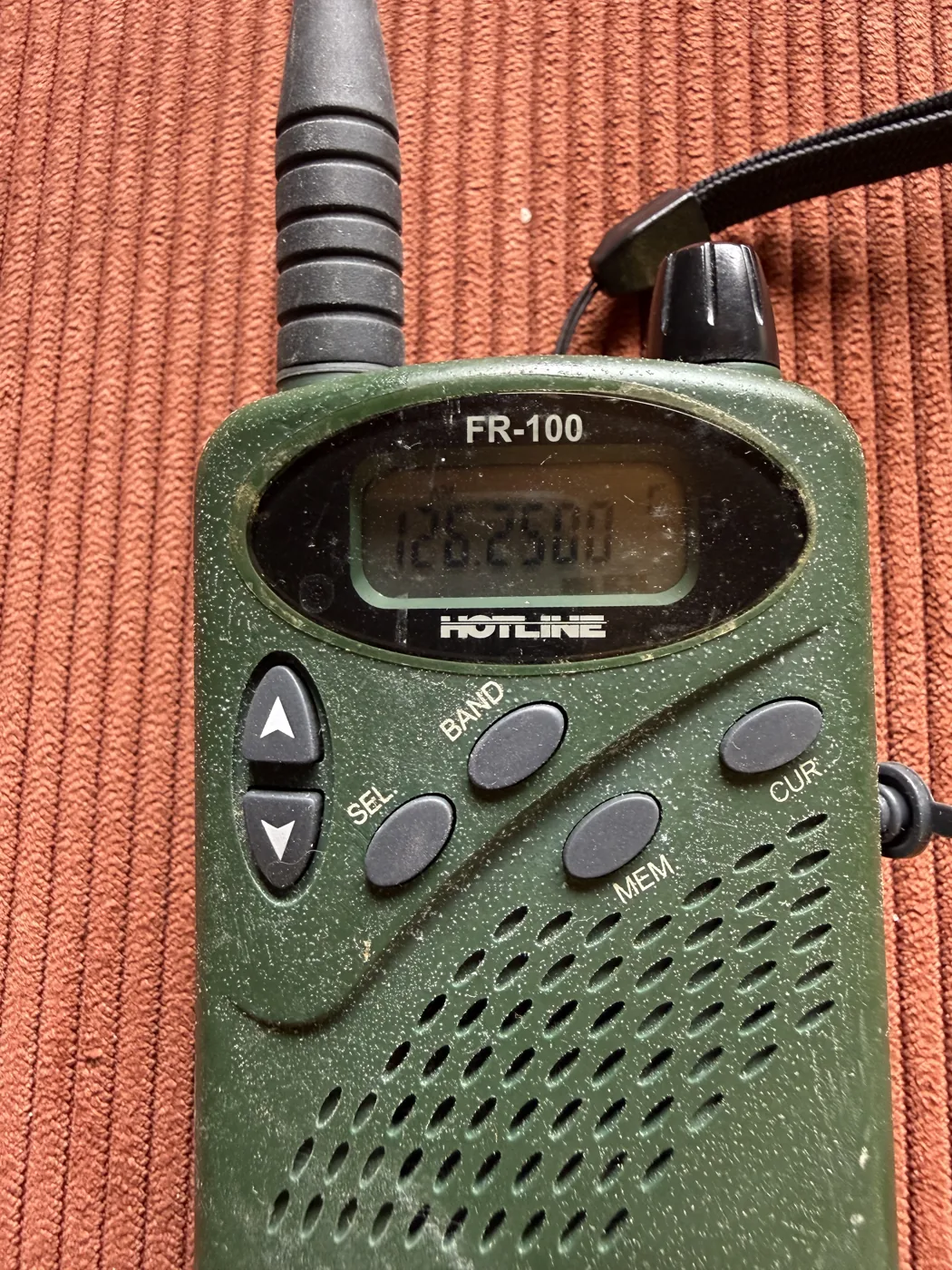
My very first radio was not even a transmitter: it was a receiver only, a Hotline FR-100, when I was a student pilot on a piston single-engine (Cessna 177), about twenty years ago. The service I got the most out of it: listening to frequencies to learn. When you are starting out, the speaking rate of some controllers and pilots is frankly terrifying, you don't understand anything. Staying on the ground, radio to the ear, decoding the phraseology, it demystifies everything: you learn the rhythm, the formulas, the music of the radio even before speaking it in flight.
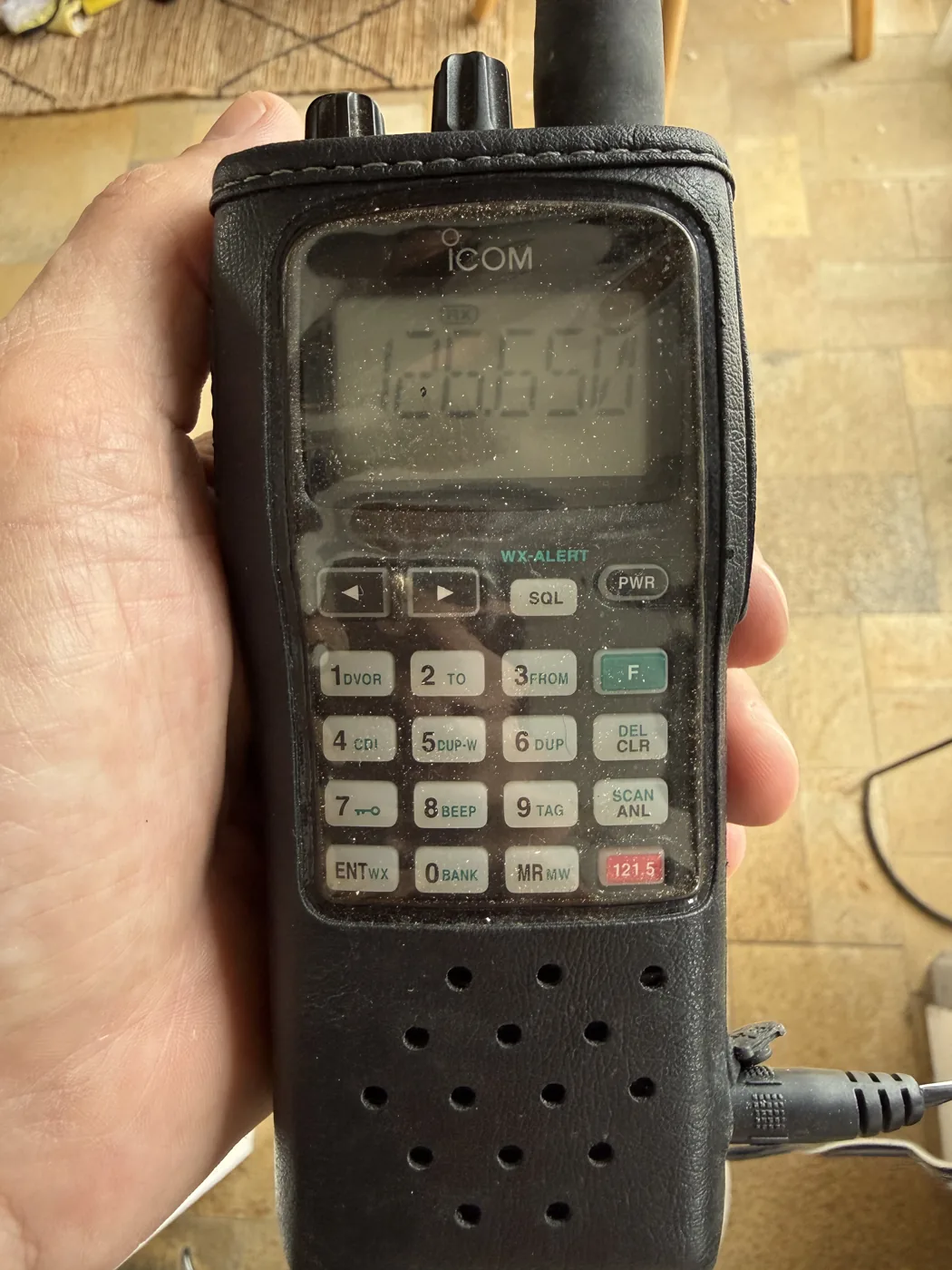
Later, in 2007, I moved to a real backup transceiver, an Icom IC-A24 that I still have. The logic: a backup radio in case the on-board radio or the electrical system fails me in flight. Two devices, two uses: to learn, then to secure oneself.
The downside, to be aware of: a radio from that era is almost certainly 25 kHz only. Perfect for learning at the time, but today, where 8.33 kHz is the standard, it no longer allows you to tune most frequencies accurately. For a purchase today: 8.33 kHz, without exception (see below).
The comparison
| Criteria | Icom A25CE | Icom A25NE | Yaesu FTA-550L | Yaesu FTA-750L |
|---|---|---|---|---|
| Type | COM only | NAV (VOR) + COM | NAV (VOR/ILS) + COM | NAV (VOR/ILS) + COM |
| 8.33 kHz | Yes | Yes | Yes | Yes |
| Power (PEP) | 6 W | 6 W | 5 W | 5 W |
| Navigation | No | VOR (no ILS) | VOR + ILS (localizer) | VOR + full ILS |
| GPS | No | Yes | No | Yes (WAAS) |
| Bluetooth | No | Yes | No | No |
| Battery life | ~10.5 h | ~10.5 h | Li-ion (n/a) | Li-ion (n/a) |
| Waterproofing | IP57 | IP57 | IPX5 | IPX5 |
| Indicative price (€) | ~€459 | ~€699 | ~€420 | ~€520 |
Other options: Icom IC-A16E (very robust COM, built for the noise of the apron, and it transmits like the others, from ~€339 at pilotshop.lu), Yaesu FTA-250L (entry-level COM, from ~€229 depending on retailer), Sporty's PJ2 (COM + GPS + Bluetooth, € price unchecked). ⚠️ The COM model (A25CE) has neither GPS nor Bluetooth: GPS, Bluetooth and VOR are reserved for the NAV/COM model (A25NE). This is not a European restriction: the US COM version lacks it too. Specs: Icom, Yaesu, Sporty's; prices pilotshop.lu / boutique.aero, indicative and subject to verification.
The European reality (read before buying)
1. 8.33 kHz is mandatory. Commission Implementing Regulation (EU) No 1079/2012 imposed 8.33 kHz channel spacing in the Single European Sky; the conversion of voice frequencies 118 to 137 MHz was to be completed by December 31, 2018 (framework since taken up by Regulation (EU) 2023/1770). A few frequencies remain in 25 kHz, such as 121.5 MHz (emergency) and 123.1 MHz (SAR auxiliary, search and rescue). In short: a handheld bought today for Europe must support 8.33 kHz. Recent Icom A25/A16E and Yaesu FTA do; flee from old 25 kHz-only devices.
2. Transmitting requires an authorization. Owning a radio does not give the right to speak on aeronautical frequencies. It generally requires a station license and a radiotelephone operator's certificate. The framework varies by country: BIPT (Belgium); in France, the ANFR manages frequencies and the station license, the operator's certificate falls under the DGAC (for a pilot, this privilege is practically carried by their license); OFCOM (BAKOM) and FOCA (Switzerland); national authority in Luxembourg. Check before transmitting, you don't use a handheld to "chat". Note also: listening to frequencies to learn is tolerated, but capturing and disclosing the content is not (secrecy of correspondence); and a handheld used on the ground requires its own authorization.
3. The emergency frequency 121.5 MHz is only used in a real emergency situation, and remains strictly regulated. It is never cluttered with tests.
Who it's for
- Student / listening / budget: an 8.33 kHz COM is sufficient, Icom A25CE, Yaesu FTA-250L, or IC-A16E, very robust and built for the noise of the apron.
- Navigation backup: a model with VOR/ILS: Yaesu FTA-550L (without GPS) or FTA-750L (with GPS).
- The most comprehensive (VOR + GPS + Bluetooth): Icom A25NE.
Good to know
- • Reduced range. Short antenna held in hand, and from a metallic cockpit the range drops even further: well below an on-board radio connected to the external antenna. An external antenna adapter (BNC) helps. It is a backup, not a replacement.
- • It is not a distress beacon. A handheld VHF does not replace an ELT (406 MHz beacon) or a PLB.
- • Regulated transmission. License + operator's certificate depending on your country; do not clutter frequencies, especially 121.5.
- • 8.33 kHz. Check this before buying: a 25 kHz-only radio is no longer suitable in Europe.
- • Accessories. Consider a spare battery, an emergency AA battery case, and the aviation headset adapter (often optional).
Where to buy
In French-speaking Europe: pilotshop.lu, Bayo, boutique.aero.
On Amazon. The five radios below are sold there, and all of them are transceivers, the Icom IC-A16E included. ⚠️ Beware of a trap: I deliberately do not put any link to the old IC-A24, which does not cover the 8.33 kHz spacing required in Europe.
Affiliate links, see the disclaimer at the bottom of the page.
Amazon links, where all five radios are sold. The two Icom radios are also stocked by my retail partner, OpaleAero, where the code LABODUPILOTE gives 2.5% off, to be entered in the "Bons de réduction" (discount vouchers) field of the basket. Prices and shipping are from France. Outside the EU, customs and shipping may exceed the discount. The three Yaesu models are not: my partner does not stock them, and I am not going to send you looking for a product they do not carry.
Frequently asked questions
Is 8.33 kHz mandatory?
Can I transmit freely with a handheld?
Does a handheld replace the on-board radio?
Do I need VOR/ILS on the radio?
In the same section
Transparency this page contains commercial links (Amazon, OpaleAero). If you buy through these links, I may earn a commission at no extra cost to you, it does not change anything to my ranking: I compare by actual use, not by commission.