In short
- A discount code in your school's name: 15 % for your students, €50.15 instead of €59, valid for one year.
- No contract, no commitment, nothing for you to sell. You share the code, that is all.
- One edition per country (France, Belgium, Switzerland, Luxembourg), in English and in French, close to 150 pages.
- Schools in Switzerland and Belgium have already agreed to share it with their students.
Why it matters to your school
The medical certificate comes first. A professional student takes the initial Class 1 before committing to training costs; a private student needs a Class 2 or LAPL certificate before the first solo flight. Enrolment, or just before it, is when the medical gets prepared.
A student who has prepared arrives with the right documents, knows the waiting times in their country, and knows what to do if the examiner asks for a further opinion. They ask your instructors fewer questions on a subject that is not theirs. The decision always stays with the doctor: the guide never gives an opinion on anyone's fitness.
For your students, a free A4 sheet with no advertising: when to take the medical, where, what to bring, with two QR codes to the checklist and the calculator. Download the sheet (PDF, 1 page). Print it or pass it on as it is.
What the guide covers
- The system, in ten pages. The certificates, who examines what, validity periods by age, revalidation versus renewal.
- The countdown, from D-90 to the day. What to do, when, in what order, with the medical placed before training costs.
- The examination from the inside. Every station: questionnaire, ECG, audiogram, vision, lab tests, EEG, and the three possible outcomes.
- Complicating cases. Medical history, current treatment, refractive surgery, blood pressure, sleep apnoea: how to build the file.
- If it goes wrong. Referral, unfitness, appeals: the time limits and the steps to take.
- The annex for the student's country, kept up to date for twelve months, and printable tools: documents to bring, countdown sheet, questions for the examiner.
To judge for yourself, one full station of chapter 3 is free to read: the electrocardiogram, as a PDF. You can pass it on to your students as it is.
Who wrote it, who reviewed it
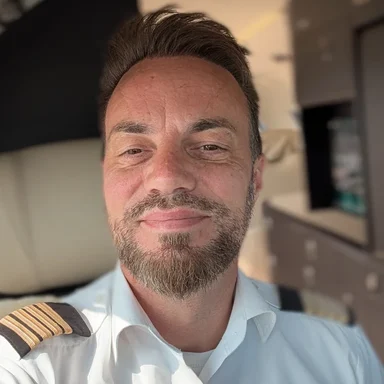
Fabian Voncken, airline pilot (ATPL), captain on the Falcon 2000LX. Former FI(PPL) and ATPL theory instructor. Before flying for a living, a nurse at the CHUV university hospital in Lausanne: cardiology, intermediate care, emergency.
I have taken this examination about twenty times, and on the other side I have performed most of the tests it contains.
The chapter on complicating cases was reviewed by four aeromedical examiners, in France, Belgium and Switzerland. Their names and what they corrected are on the methodology page. Every figure in the guide carries the date it was checked.
How it works
- I create a code in your school's name (you may already have received it by email).
- You share it with your students however you like: at enrolment, in your welcome email, at a briefing, on your social media. I send you a checkout link with the code already filled in, and two lines ready to copy.
- The student chooses the edition for their country and receives their copy, in their name, by email within minutes.
- In two months, I tell you how many of your students used the code, even if the answer is zero.